

 Home
An industrial crane is usually chosen long before the site is ready for installation. That makes the early details important: the heaviest load, the space it must travel through and how often the operator will lift it. A crane that looks right on a catalogue page may not clear a column, reach a machine or suit the actual production cycle.
When searching for Industrial Lifting Crane manufacture in india, buyers are generally looking for a manufacturer who can discuss the full lifting arrangement rather than capacity alone. Axis Cranes can be approached with an application brief covering the load, available space and intended operation. The goal is to identify a configuration worth evaluating against the project's engineering requirements.
What Is an Industrial Lifting Crane?
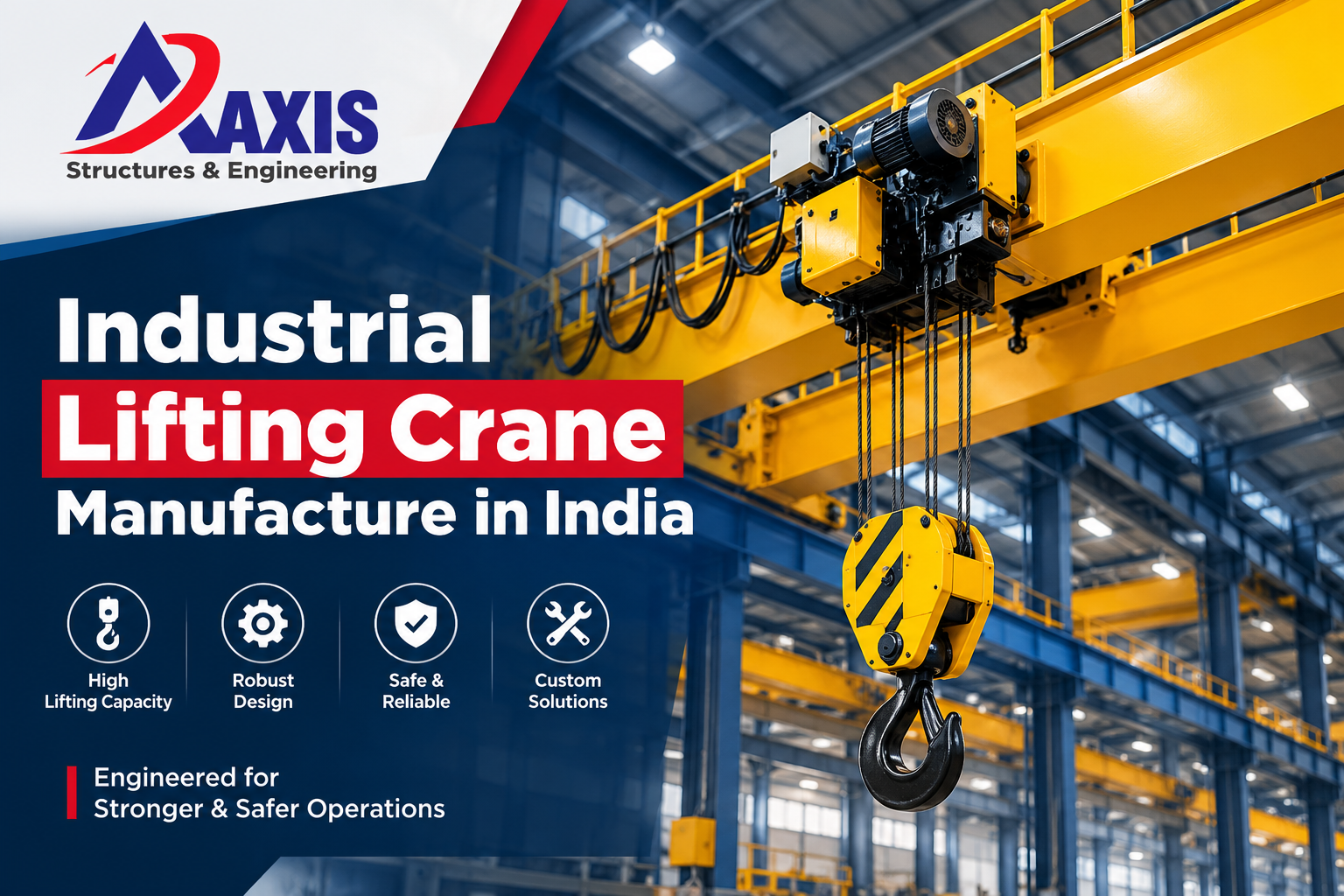
An industrial lifting crane combines a lifting mechanism, such as an electric wire rope hoist, with a structure that positions the load. Depending on the design, the operator may move the hook up and down, across a bridge, along a runway or around a jib pivot.
A crane is not simply a larger hoist. A hoist performs the lifting action; the crane arrangement provides the working area and supports the relevant motions. That distinction matters when you compare quotations.
What the crane must do on site
- Lift a defined maximum load within its engineered rated capacity.
- Move material between specified loading and unloading positions.
- Provide enough hook height, approach and clearance for the actual job.
- Suit the expected starts, stops and lifting frequency.
- Integrate appropriate controls, brakes, limits and other required safeguards.
Types of Industrial Lifting Cranes
No single crane layout works for every factory. The main decision is often whether loads need broad building coverage, movement across an outdoor yard or handling around one workstation.
1. Single-girder EOT crane
A single-girder electric overhead travelling (EOT) crane uses one main bridge girder and a suitable hoist arrangement. It can be considered where its engineered capacity, span, headroom and duty suit the requirement. Do not assume a single girder is automatically suitable just because the load seems modest.
2. Double-girder EOT crane
A double-girder crane uses two bridge girders supporting a trolley or hoisting arrangement. The configuration may be selected when the project calls for a particular combination of loading, span, hook approach, lift height and duty. Selection needs a drawing and calculation, not a blanket tonnage rule.
3. Gantry and semi-gantry crane
A gantry crane is carried on legs and normally travels along an engineered ground-level rail path. A semi-gantry arrangement uses different support levels on its two sides. These options may be useful where an elevated building-supported runway is impractical.
4. Jib crane and localised lifting
A jib crane works around a fixed pillar or wall-supported pivot, subject to its designed range of movement. It is often evaluated for loading a machine, handling components at a work cell or serving a restricted area. The support foundation or wall structure must be checked.
Editorial note: This is proposed technical-team wording, not a verified statement from an Axis Cranes employee. Obtain team approval before publishing it as an attributed quote.
Common Industrial Crane Applications
Applications differ in cycle frequency, surrounding equipment and load characteristics. A lifting solution should be specified for the work actually being performed.
- Fabrication workshops: moving plate assemblies, frames and fabricated structures between stations.
- Engineering and machine shops: loading large workpieces onto machines and positioning fixtures.
- Warehouses and dispatch areas: handling heavy equipment that cannot practically be moved with a forklift alone.
- Steel and foundry facilities: process-dependent lifting that may involve heat, dust or demanding duty.
- Power and process plants: planned maintenance lifts for motors, pumps and equipment components.
- Outdoor material yards: suitable gantry arrangements for defined handling routes.
How to Choose an Industrial Lifting Crane
Start with the lifting operation, then confirm whether the proposed structure and crane mechanism can safely achieve it. A capacity figure by itself does not describe a complete crane.
Define the maximum load and lifting accessories
Record the heaviest item and identify slings, magnets, grabs, lifting beams or other below-hook equipment where relevant. The engineer must account for the entire lifting arrangement and its effects, including any special loads.
Measure span, lift height and hook approach
For a bridge crane, span typically means the distance between runway rail centres. Height of lift is the available vertical hook travel, while hook approach influences how close the hook can get to the runway ends or sides. All three measurements solve different problems.
Specify operating frequency and duty
Explain the expected number of lifts, typical load sizes, travel frequency and shift pattern. A maintenance crane used occasionally does not have the same service profile as a production crane working repeatedly through the day.
Check runway, building and foundation constraints
An EOT crane may impose vertical and horizontal forces on runways and supporting steelwork. A gantry or jib crane transfers loads differently. Obtain a site and structural assessment rather than assuming existing beams or concrete can take the new equipment.
Industrial Lifting Crane Specifications to Compare
The items below are quotation and engineering checks, not published Axis Cranes product ratings. Ask for the approved general arrangement drawing, applicable calculations and model-specific documentation.
- Crane configuration: single girder, double girder, gantry, semi-gantry or jib.
- Rated lifting capacity and type of load-handling attachment.
- Span, hook height, approach distances and end clearances.
- Long-travel and cross-travel distances where applicable.
- Service or duty classification based on the load spectrum and operating cycles.
- Hoist mechanism, lifting speed, travel speeds and control arrangement.
- Runway rail, wheel loads, support design and installation interface.
- Power supply, cable festoon or conductor system and required electrical protection.
- Limit switches, brakes, overload protection and other specified safety features.
- Ambient conditions, dust, corrosion, heat exposure and any special environment requirements.
- Inspection, testing, documentation and the project-specific standards to be applied.
Standards note: For applicable electric overhead travelling and gantry cranes, buyers can discuss IS 3177:2020 and IS 807:2006 (including relevant amendments). The responsible engineer should verify scope, current editions and project requirements. Mentioning these standards does not imply certification or compliance of a particular Axis Cranes product.
Buyer Tips and Common Crane Selection Mistakes
Buyer tip: send a marked-up site layout
A simple drawing showing columns, machines, pits, doorways and load positions is more useful than a message saying “need a 5-ton crane.” If drawings are unavailable, provide measured dimensions and photographs with reference points.
Buyer tip: explain the lift path
Describe where material is picked up, carried and placed. Check for ducts, lights, conveyors and obstacles. An otherwise correct crane can still have a poor working envelope.
Common mistake: comparing quotes only by tonnage
Two cranes with the same stated capacity may differ in span, lift height, duty, controls, component selection and support loads. Ask vendors to quote against one agreed specification sheet.
Common mistake: ignoring the building structure
The existing shed is not automatically crane-ready. Runway beam size, column reactions, bracing and foundation capacity need qualified review before procurement and installation.
Common mistake: overlooking headroom and approach
A few centimetres of missing hook clearance may stop the intended lift. Review the general arrangement drawing against the tallest load, rigging height and end-of-travel positions.
Common mistake: leaving testing and maintenance until handover
Agree on installation responsibilities, inspection access, load-testing procedures, maintenance information and operator training before placing the order. Safety devices must never be bypassed to gain additional travel or capacity.
Industries Where Industrial Lifting Cranes Are Used
Industrial lifting cranes support material movement in facilities such as:
- General engineering and heavy fabrication workshops
- Automotive components and machinery assembly plants
- Steel processing, fabrication and foundry operations
- Warehousing, logistics and industrial dispatch facilities
- Power generation and equipment maintenance sites
- Infrastructure fabrication and industrial project yards
Industrial Lifting Crane Manufacturer in India — Axis Cranes
If your requirement involves an industrial EOT crane, gantry crane or jib crane, share the site details with Axis Cranes for a configuration and quotation discussion. The right first conversation should cover movement, support and duty—not just a rated tonnage.
- State the maximum and typical lifted loads, including attachments.
- Provide span, required hook height and travel-area dimensions.
- Explain lift frequency, working shifts and operating conditions.
- Send site drawings and identify runway or foundation constraints.
- Request the proposed arrangement, specifications and clarification of inclusions.
For an existing building, mention any uncertainty about roof height, supports or clearances early. That information can change the preferred crane arrangement before a quotation becomes a purchase order.
Frequently Asked Questions — Quick Buyer Answers
What is an industrial lifting crane?
An industrial lifting crane is a powered or manually operated material-handling system that raises, lowers and positions loads using a hoist and a supporting structure. The crane type depends on the building, operating area, load and required movement.
Which industrial lifting crane types are commonly used in India?
Common configurations include single-girder and double-girder EOT cranes, gantry or semi-gantry cranes, jib cranes and workstation lifting systems. The right type depends on coverage, runway support, lifting height and duty.
How do I choose the right crane lifting capacity?
Start with the heaviest actual load, including lifting accessories where applicable. A responsible engineer must establish rated capacity and allowances for the specific application; capacity alone does not determine a suitable crane.
What is the difference between an EOT crane and a gantry crane?
An EOT crane typically travels on elevated runway beams supported by the building or dedicated structure. A gantry crane travels on legs supported by rails or another engineered ground-level path. Site constraints determine the better option.
What is crane span and how is it measured?
For a typical bridge crane, span is the centre-to-centre distance between the runway rails. It is different from lifting height and from the building width; confirm the measurement convention on the general arrangement drawing.
Why does crane duty classification matter?
Duty classification reflects intended service conditions, including use frequency and load spectrum. A crane that occasionally lifts its rated load may need a different mechanism and structural design from one used repeatedly throughout a shift.
Which standards should buyers discuss for industrial cranes in India?
For applicable electric overhead travelling and gantry cranes, discuss IS 3177:2020 and the structural provisions of IS 807:2006, including amendments. Project-specific requirements and current applicability must be confirmed by the responsible engineer.
What information should I send Axis Cranes for a quotation?
Share the maximum load, application, proposed crane type, span, lift height, hook approach, travel distances, operating frequency, site drawings, power supply, environment, installation constraints and required quantity.
Planning an Industrial Lifting Crane?
Send Axis Cranes your load details, span, required lifting height, site layout and operating duty to start a practical crane specification and quotation discussion.
Send an Enquiry WhatsApp Us


