


 Home
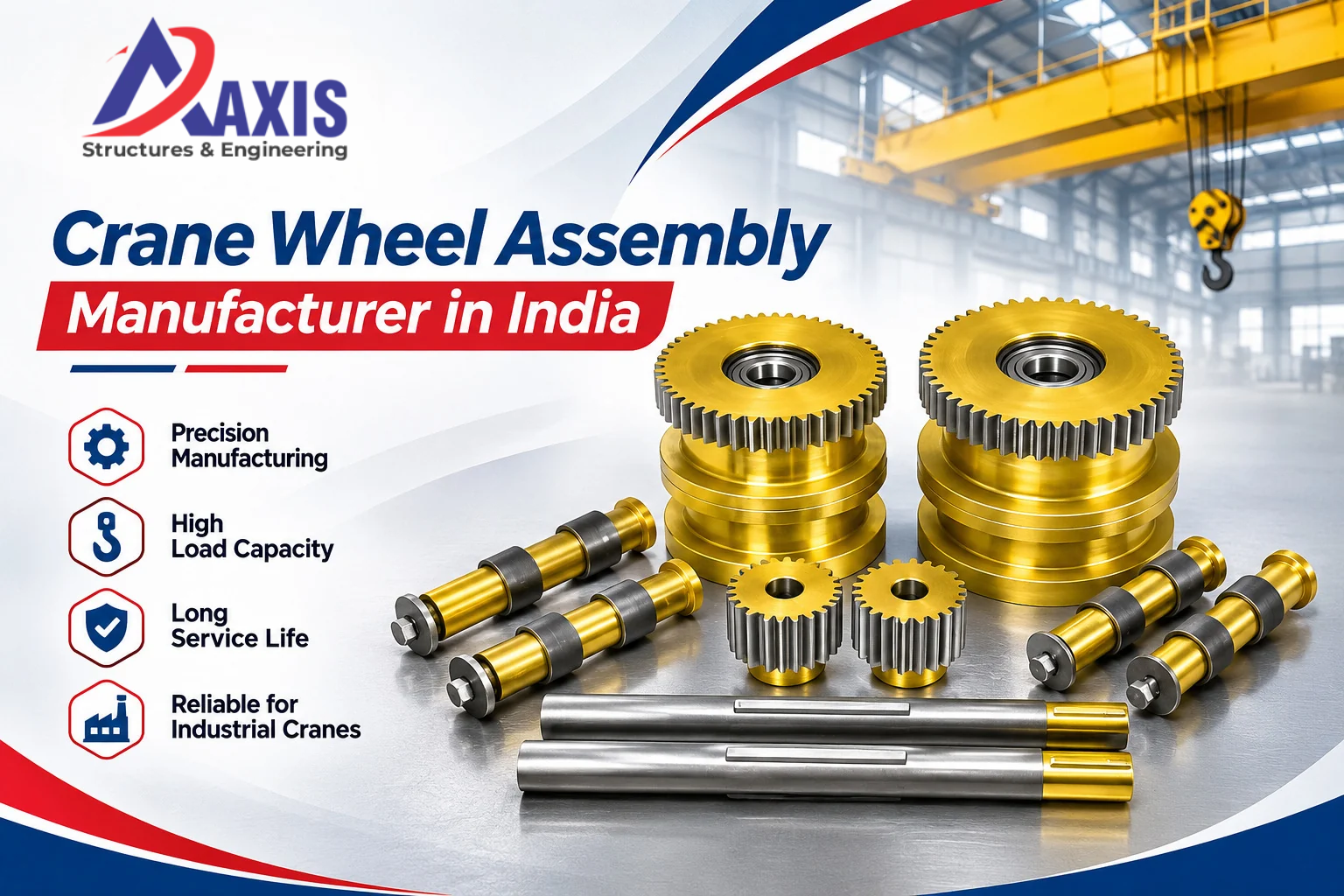
A crane can be running smoothly for years and then start making a scraping sound on one runway. The first thought is often, “We need new wheels.” Sometimes that is true. But if the rail, bearing or wheel alignment is the real cause, a new set may wear the same way.
For buyers looking for a Crane Wheel Assembly Manufacturer in India, the important question is not only wheel diameter. Axis Cranes can be approached with the existing assembly drawing, travel-drive details and rail information to discuss a suitable requirement. This guide covers what a crane wheel set does, which dimensions matter and what to inspect before ordering.
What Is a Crane Wheel Assembly and How Does It Work?
In an overhead crane, wheels carry vertical load into the runway rail while allowing controlled long travel or cross travel. Some wheels are driven through a gearbox and coupling; others are non-driven. Flanges, where fitted, help guide the wheel on the track but are not a substitute for correct rail alignment.
A crane wheel is the rolling part. A crane wheel assembly can also include its shaft, bearing supports and fittings. A bare replacement wheel and a fully assembled wheel block are different purchases, even if a supplier describes both as a “wheel set.”
What a correctly selected crane wheel set must provide
- Load transfer to the rail within the crane's approved design limits.
- Matching tread and flange geometry for the specified rail profile.
- Correct shaft, bearing and housing interfaces for mounting.
- Compatible driven or idler arrangement and connection details.
- Inspectability and serviceability under the equipment maker's procedure.
Crane Wheel Assembly Types and Main Components
There is no single assembly that suits every EOT crane, gantry crane and trolley. The wheel profile, load path and bearing arrangement must follow the machine design.
1. Driven crane wheel assemblies
A driven wheel receives torque from a motor and gearbox through a specified shaft, coupling, gear or other transmission connection. When requesting one, identify the drive-side interface, keyway or spline details if applicable, and the direction and position of the wheel on the machine.
2. Non-driven or idler wheel assemblies
An idler wheel supports and rolls with the crane without directly receiving travel-drive torque. It still needs the correct bearing arrangement, load capacity, axial location and wheel profile. An idler is not automatically interchangeable with a driven wheel.
3. Single-flange and double-flange wheels
Flanges guide the rolling wheel relative to the track. Single-flange and double-flange versions have different guiding geometries. Tread width, flange thickness, flange height and clearances must be checked against the original assembly and rail layout, not guessed from a photograph.
4. Wheel, shaft, bearings and bearing housings
The assembly may use a rotating shaft supported by bearings or a wheel rotating on a fixed axle. Bearing type, mounting fits, seals, lubrication access and retainers depend on that arrangement. Before asking for a “complete assembly,” specify exactly which components are included.
Editorial note: This is proposed copy, not a verified employee quotation. Obtain approval from the Axis Cranes technical team before publishing it as an attributed quote.
Where Crane Wheel Assemblies Are Used
Wheel assemblies are found in several types of rail-guided lifting and handling equipment. The same words are used across machines, but the mounting details and duty can differ considerably.
- EOT overhead cranes: bridge long-travel wheels and trolley cross-travel wheels.
- Gantry and goliath cranes: wheels running on ground-level or elevated crane rails.
- Crane trolleys: compact travel wheels carrying the hoist or crab structure.
- Transfer cars and rail-guided handling equipment: application-specific rolling assemblies.
- Industrial crane maintenance: replacement of damaged, worn or non-serviceable wheel sets.
- Crane refurbishment: evaluation of existing wheel, bearing and shaft interfaces before replacement.
How to Select the Right Crane Wheel Assembly
Start with the OEM drawing or original part number. A wheel that has the right outside diameter can still be unsuitable if its tread, bore, shaft ends or bearing positions differ.
Match the wheel tread to the rail
Record the rail designation and dimensions, wheel tread diameter and effective running width. Flange clearance and the contact profile matter. Ask an engineer to verify the wheel-to-rail pairing rather than assuming all wheels for the same crane capacity are identical.
Confirm the load case and travel duty
Crane safe working load alone does not equal the maximum load on each wheel. Self-weight, trolley position, lifted load, wheel spacing and dynamic effects influence wheel reactions. Engineering selection should use the approved design load cases and operating duty, including travel speed and cycling.
Check shaft, bearing and drive fitment
Record bearing references, shaft-end diameters and lengths, shoulders, keyways, seals and mounting bolt locations as applicable. Verify whether the wheel is keyed, pressed, mechanically retained or mounted in another way. A slightly wrong shaft end can stop an otherwise correct wheel from fitting.
Discuss material and heat treatment without guessing a grade
Crane wheel designs may specify steels such as C45 or selected alloy steels, together with a heat-treatment condition or hardened tread. The correct grade, hardness range and depth depend on design, rail compatibility and service duty. These are examples for engineering discussion, not confirmed Axis Cranes product specifications.
Crane Wheel Assembly Specifications to Confirm Before Ordering
Use this as an enquiry checklist, not an Axis Cranes technical datasheet. Final sizes, tolerances, material and test requirements should come from the approved drawing and supplier documentation.
- Crane type, make, model, original wheel drawing or part reference.
- Required quantity and wheel location: bridge, trolley, drive side or idler side.
- Outside diameter, tread diameter, tread width and running-surface profile.
- Single or double flange; flange height, thickness and overall wheel width.
- Rail section/designation, head width and track layout information.
- Wheel bore, hub dimensions, shaft diameter, shaft-end geometry and keyway details.
- Bearing type and number, housing, seal, retaining and lubrication arrangement.
- Drive coupling or gear connection, where applicable.
- Approved wheel loads, operating duty, travel speed and environmental conditions.
- Specified steel grade, heat treatment, hardness requirements and inspection criteria.
- Dimensioned drawing, photos of the old assembly, and quotation scope.
Standards and safety note: Crane design and inspection requirements may reference relevant IS, ISO or FEM documents depending on the project, equipment and jurisdiction. A standard reference does not itself establish an individual wheel's dimensions or certification. Ask which edition and provisions apply to your order; have load-bearing replacements approved and installed by competent personnel.
Buyer Tips and Common Crane Wheel Replacement Mistakes
Buyer tip: send a drawing, even if it is old
An older wheel drawing with clear dimensions is usually more useful than several photos taken from one angle. Mark which measurements are from the drawing and which were measured from a worn wheel; wear can change the apparent tread and flange dimensions.
Buyer tip: photograph the rail as well as the wheel
Take photos of both wheel flanges, the tread, bearing housing and the rail contact area. If only one flange is shiny or heavily worn, include both sides of the crane. That detail can help identify what should be inspected next.
Buyer tip: define 'complete assembly' in the quotation
Ask whether the price covers the bare wheel, fitted shaft, bearings, housings, seals, fasteners and any testing or documents. This avoids comparing two quotations that actually cover different supply scopes.
Common mistake: ordering only by crane tonnage
Two cranes with the same rated capacity can have different span, trolley weight, wheel loads and rail sections. Capacity is background information, not a dimensional specification for a wheel assembly.
Common mistake: replacing wheels but ignoring rail skew
Misaligned tracks, unequal wheel diameters, worn bearings or bridge skew can create abnormal flange contact. New wheels do not fix those conditions. Inspect the running system and correct the cause under the crane OEM's guidance.
Common mistake: selecting hardness without looking at the rail
Hardness is not a simple 'higher is better' decision. Wheel material and heat treatment need to be considered alongside rail material, contact stress and required toughness. Request documented specifications instead of selecting a wheel from a headline hardness number.
Industries Using Crane Wheel Assemblies
Rail-travelling cranes and their wheel systems are used across many industrial facilities, including:
- Steel plants, rolling mills and metal-processing units
- Heavy engineering and machine-building workshops
- Fabrication yards and structural-steel facilities
- Ports, logistics yards and bulk-material handling sites
- Power generation and process-industry maintenance
- Precast, infrastructure and industrial construction operations
Crane Wheel Assembly Manufacturer in India — Axis Cranes
When contacting Axis Cranes about a crane wheel assembly, describe the machine and the part you need rather than relying on a generic “EOT crane wheel” enquiry. The points below give the technical discussion a useful starting point without assuming a particular stocked size or manufacturing capability.
- Provide the machine and wheel assembly make/model, if known.
- Attach the original part drawing or legible measurements and photos.
- Confirm rail dimensions, flange type and tread profile.
- Identify driven versus idler location and bearing/shaft arrangement.
- Ask Axis Cranes to confirm supply scope, material specification, fitment and available documentation.
If the wheel has failed more than once, mention the wear pattern or bearing symptoms. A clear technical enquiry helps separate a simple part replacement from a wider alignment or travel-system problem.
Frequently Asked Questions — Short Buyer Answers
What is included in a crane wheel assembly?
A crane wheel assembly typically brings together a travel wheel, shaft or axle arrangement, bearings and relevant housings, seals and retainers. The exact supply scope varies by crane design, so confirm whether you need a bare wheel, wheel-and-shaft set or complete ready-to-fit assembly.
How do I select a replacement EOT crane wheel assembly?
Match the crane drawing or OEM part reference, wheel diameter, tread and flange profile, rail section, shaft interfaces, bearing arrangement, mounting dimensions and duty. Also check the condition and alignment of the rail and mating drive components.
Which materials are commonly considered for crane wheels?
Engineered steel grades such as C45 or alloy steels may be considered depending on load, duty and design requirements. Heat treatment, hardness depth and toughness must be established from the approved engineering specification; no single grade is correct for every crane.
What is the difference between a single-flange and double-flange crane wheel?
A single-flange wheel has one guiding flange, while a double-flange wheel has two. The correct choice depends on the crane guidance arrangement, track geometry, clearances and original design; the flange count alone does not determine interchangeability.
Why do crane wheel flanges wear unusually fast?
Rapid flange wear can be linked to rail misalignment, skewing, unequal wheel diameters, poor wheel alignment, defective bearings or unsuitable wheel-to-rail contact. Investigate the travel system before replacing a worn wheel.
Can a crane wheel be replaced without replacing its shaft and bearings?
Sometimes, if the approved design permits separate replacement and the shaft, bearings, fits and retaining features pass inspection. For other designs the assembly should be changed together. Follow the equipment manufacturer’s service procedure.
Which measurements should I send for a crane wheel quotation?
Provide a drawing or part number, outer diameter, tread diameter and width, flange dimensions, wheel bore, shaft ends, bearing details, rail size, drive arrangement, quantity and clear photographs. Mention crane capacity and operating duty as context, not as a substitute for design data.
Are crane wheel assemblies made to one universal standard size?
No. Crane wheels vary by rail profile, load path, mounting arrangement, duty and manufacturer design. Relevant crane standards can guide engineering and inspection, but dimensional interchangeability must be verified from the approved drawing.
Need a Crane Wheel Assembly for Your Crane?
Share your crane wheel drawing, rail size, wheel dimensions, shaft and bearing details, duty and photos with Axis Cranes. Ask for the proposed supply scope and fitment details before placing an order.
Send an Enquiry WhatsApp Us


