
 Home
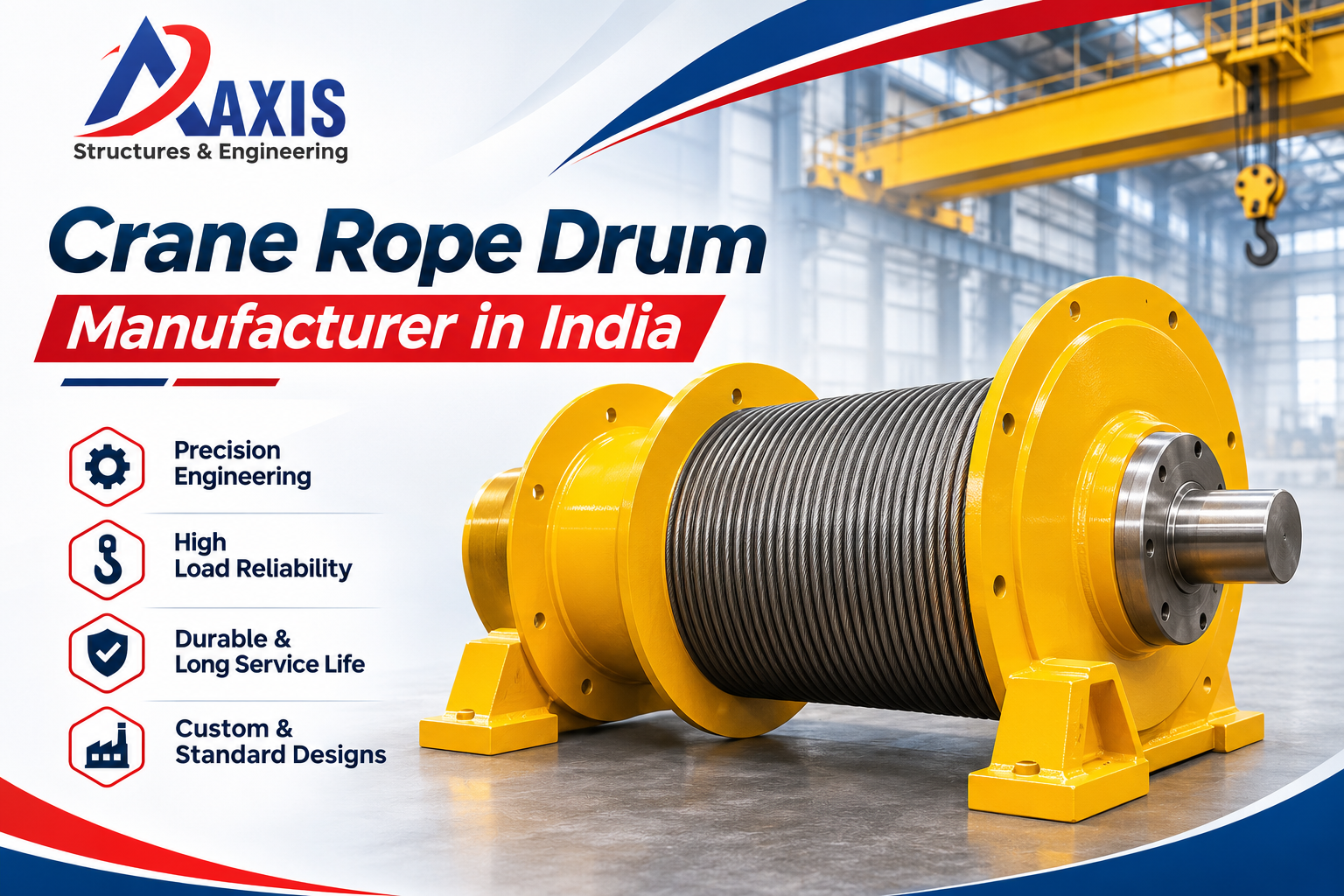
On a crane, the rope drum looks like a straightforward rotating cylinder. In service, small details make the difference: the groove must suit the wire rope, the rope must wind without riding over adjacent turns, and the drum must connect correctly to the hoist drive. A replacement that is right on overall length but wrong on groove pitch can create trouble almost immediately.
If you are looking for a Crane Rope Drum Manufacturer in India, Axis Cranes includes rope drums in its crane components range. This guide explains what to check on an EOT crane, gantry crane or wire rope hoist before ordering a new drum or matching an existing one.
What Is a Crane Rope Drum and How Does It Work?
A wire rope drum is driven through the hoist gearbox or another engineered drive arrangement. As the drum turns, wire rope winds onto or pays off its cylindrical surface. The reeving system, sheaves and hook block determine how this movement translates into hook travel.
It is important not to confuse the rope drum with a brake drum. The rope drum stores and guides the lifting rope; the hoist brake controls motion through its designated braking arrangement. They perform different jobs, even when both are part of one hoist assembly.
Parts that matter in a rope drum assembly
- Drum shell: the cylindrical body that carries rope contact and winding loads.
- Grooves or winding surface: guide the specified rope size and winding pattern where provided.
- End flanges: help retain the wound rope within the drum's designed limits.
- Hub, shaft or drive interface: transfers rotation from the hoisting mechanism into the drum.
- Rope anchorage: secures the rope end according to the approved drum and hoist design.
- Bearings and supports: keep the assembly correctly positioned under operating loads.
Rope Drum Types, Grooves and Construction
There is no one drum arrangement for every crane. Rope diameter, lifting height, number of falls, available drum length and spooling geometry all affect the design. Ask which construction matches your equipment instead of ordering only by capacity.
1. Grooved rope drum
A grooved crane rope drum has a machined rope path. Groove pitch, depth, radius and direction have to suit the selected wire rope and the way it approaches the drum. On suitable single-layer arrangements, grooves help maintain orderly winding.
2. Plain or smooth rope drum
A plain rope drum has a smooth winding surface. It may be used where the equipment design provides appropriate spooling control, but it is not an automatic substitute for a grooved drum. Check the original rope-management arrangement first.
3. Single-layer and multi-layer winding
With single-layer winding, rope sits in one layer along the drum. Multi-layer winding puts additional turns over earlier layers and introduces different rope contact pressures and crossovers. Multi-layer service needs a deliberately engineered spooling arrangement; simply making the drum longer or deeper is not enough.
4. Fabricated and cast construction
Depending on the approved design, drums may be fabricated from specified steel sections or made using cast components. Shell thickness, welds, hubs, machining and inspection requirements vary. These are industry construction approaches, not a claim that every option is available from Axis Cranes.
Where Are Crane Rope Drums Used?
Rope drums are used in lifting mechanisms that wind steel wire rope. The drum dimensions and arrangement depend on the crane design, rather than simply the industry where the crane operates.
- EOT overhead cranes: wire rope hoisting mechanisms in factory and workshop crane systems.
- Gantry and goliath cranes: hoisting units used in yards and material-handling operations.
- Electric wire rope hoists: compact or integrated drum-and-drive assemblies.
- Winches: engineered rope winding for lifting or pulling duties, as applicable.
- Crane refurbishment: replacement drums when grooves, shells or connections no longer meet service requirements.
How to Select a Crane Rope Drum
Start with the hoist OEM drawing when possible. If it is missing, document the installed drum carefully before dismantling, and have the design checked by a qualified crane engineer. Rated lifting capacity by itself does not define the rope drum.
Confirm rope diameter, construction and reeving
Record the wire rope diameter, construction, number of falls and reeving path. Two ropes with the same nominal diameter can behave differently because of construction and service requirements. Groove geometry should match the selected rope and the original hoist design.
Check drum diameter and rope bending duty
The drum's pitch-circle diameter influences how sharply the rope bends during winding. The appropriate drum-to-rope diameter ratio depends on the rope, classification, duty and applicable engineering standard. Do not apply a single universal ratio to every crane.
Calculate winding length and required travel
Lifting height, reeving ratio, rope anchorage and retained dead wraps affect how much rope the drum needs to hold. Confirm usable winding length, groove count, layer arrangement and flange clearance with the design drawing. Do not remove the required retained turns to gain extra hook travel.
Verify fleet angle and rope approach
Fleet angle is the angle at which the rope approaches the drum relative to its ideal winding direction. Excessive or unsuitable fleet angle can encourage rubbing, poor spooling and accelerated wear. Review drum position, lead sheave location and any rope guide as one system.
Match shaft, flange and gearbox interfaces
Record bearing seats, shaft ends, hubs, keyways, bolt patterns and overall assembly length. The drive connection must match the installed hoist arrangement. Do not assume a rope drum from another crane of equal capacity will bolt straight in.
Crane Rope Drum Specifications to Confirm Before Ordering
This is a practical enquiry checklist, not a published Axis Cranes specification range. Final sizes, material grades, tolerances and tests need to be confirmed against the actual drawing and operating duty.
- Crane or hoist make, model, safe working load and required lifting height.
- Wire rope nominal diameter, construction and specified rope grade where known.
- Single-layer or multi-layer winding and rope reeving arrangement.
- Drum shell outside diameter, pitch-circle diameter and overall length.
- Usable winding length, groove pitch, groove profile, direction and groove count.
- Flange diameter and thickness, rope anchorage and required retained wraps.
- Drum shaft, hub, bearing-seat dimensions and gearbox or coupling interface.
- Hoisting speed, duty classification, loading pattern and operating environment.
- Approved material specification, fabrication and inspection requirements.
- Existing drawing, clear photographs, quantity and any replacement part number.
Standards and materials note: Standards such as ISO 16625 address selection of rope drums and sheaves in relevant crane applications; ISO 4308-1 deals with wire rope selection. Applicability and editions must be checked for the project. These references do not mean an Axis Cranes product has been tested or certified to either standard. Steel grade and fabrication details must follow the approved specification.
Buyer Tips and Common Crane Rope Drum Mistakes
Buyer tip: photograph the groove close-up
Take one photo of the full drum and another close to the grooves with a scale in the frame. A photograph from across the workshop will not show groove wear or pitch accurately.
Buyer tip: mark rope winding direction
Before disassembly, note where the rope anchors, which side it leaves the drum and the winding direction. This is easy to forget once the rope is off. It matters when checking groove hand and reassembly.
Buyer tip: send the mating component details
The drum alone may not tell the whole story. Include the gearbox coupling, shaft support and lead-sheave arrangement if the replacement is not identical to the old part.
Common mistake: treating total drum length as usable winding length
Flanges, anchorage zones, groove run-outs and retained wraps use space. A drum may fit the machine frame yet have insufficient safe winding capacity for the required lift.
Common mistake: copying worn groove dimensions
A worn groove is a poor pattern for a new drum. Check the original drawing and rope specification instead of reproducing damage as if it were the intended profile.
Common mistake: replacing the drum without checking the rope path
Poor spooling can come from fleet angle, rope guide condition, sheave alignment or uneven rope tension. A new drum will not fix the underlying cause. Inspection and commissioning should follow the hoist manufacturer's procedure.
Industries Using Crane Rope Drum Assemblies
Where overhead cranes and wire rope hoists are installed, suitable rope drums may be found in:
- Steel and metal-processing facilities
- Heavy fabrication and machinery workshops
- Automotive and equipment manufacturing plants
- Warehouses and industrial material-handling sites
- Power, cement and process-industry maintenance workshops
- Construction equipment and infrastructure fabrication yards
Crane Rope Drum Manufacturer in India — Axis Cranes
Axis Cranes includes Rope Drum in its crane components and spares offering. For a useful conversation about a new or replacement drum, the starting point is your hoist arrangement and dimensional information—not an assumed standard size.
- Share the crane or hoist model, capacity and travel requirement.
- Identify the wire rope diameter, reeving and winding arrangement.
- Provide the drum drawing or shell, flange and groove measurements.
- Show the shaft, hub and gearbox connection details.
- Confirm quantity and whether the enquiry concerns replacement or a new machine.
If the old drawing is unavailable, say so. A labelled sketch with photos of both ends and the groove face is much more helpful than guessing a product code. Contact Axis Cranes to discuss the requirement and request a quotation after technical review.
Frequently Asked Questions — Short Buyer Answers
What is a crane rope drum?
A crane rope drum is a rotating cylindrical component that winds and unwinds steel wire rope to lift or lower a load. Its dimensions, groove profile, flanges and drive connection must match the hoist design.
What is the difference between grooved and plain rope drums?
A grooved drum has machined tracks that help position the wire rope during winding. A plain drum has no guiding grooves. The correct choice depends on the approved reeving, rope and spooling arrangement.
How is rope drum diameter selected for an EOT crane?
The drum diameter is selected with the wire rope diameter, construction, duty and applicable crane design requirements. The required drum-to-rope diameter ratio must be checked against the project standard and OEM design, not guessed from lifting capacity.
What details are needed to manufacture a replacement rope drum?
Provide the equipment model, existing drum drawing, rope diameter and construction, groove pitch and profile, shell and flange dimensions, winding length, number of layers, shaft or hub connection, load duty and clear photos.
Can an existing crane rope drum be re-grooved?
It may be possible after engineering inspection, but remaining wall thickness, wear, cracking, rope compatibility and the original design must be assessed. Re-machining should never be approved from photographs alone.
Why does wire rope pile up at one end of a drum?
Possible causes include incorrect fleet angle, wrong groove direction or pitch, misalignment, uneven tension and a malfunctioning rope guide. Inspect the entire reeving system before replacing only the drum.
Which materials are used for crane rope drums?
Rope drums can use engineered steel plate fabrications, steel castings or other specified constructions. Material grade, weld details, machining and inspection requirements depend on the approved drawing and operating duty.
What should I send Axis Cranes for a rope drum quotation?
Send the crane or hoist model, capacity and lifting height, wire rope details, drum dimensions, groove specification, shaft or flange interface, quantity, drawing and photographs. State whether this is a new build or replacement.
Need a Rope Drum for Your Crane or Hoist?
Share your rope diameter, hoist details, groove and drum dimensions, drive connection, lifting duty and drawings or photos. Axis Cranes can review the enquiry against your requirements.
Send an Enquiry WhatsApp Us