


 Home
Home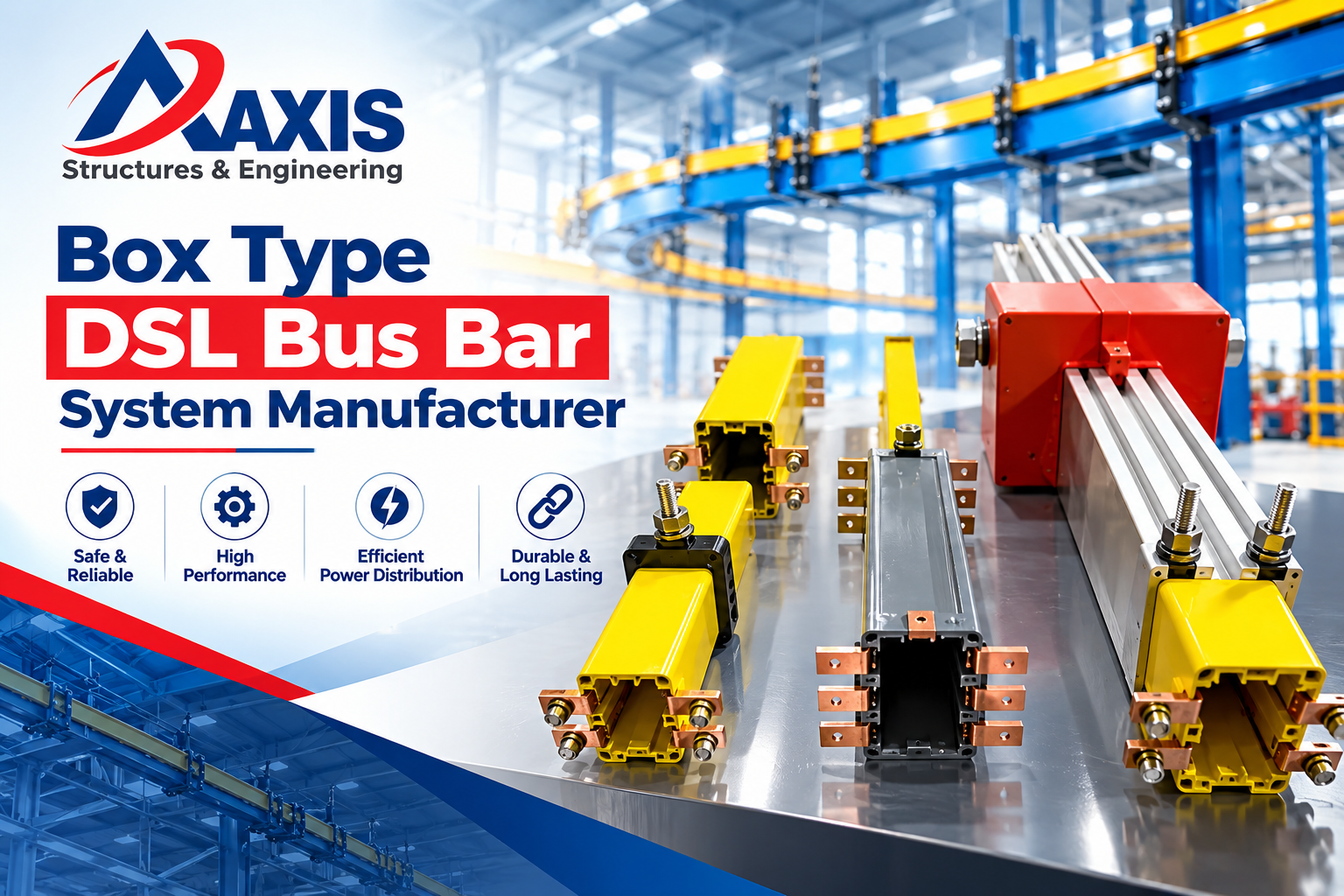
A crane can travel smoothly for metres or hundreds of metres, but its electrical supply has to move with it every second. That is the job of a DSL bus bar system: it carries electrical power along a fixed travel route so a crane or other mobile machine can stay energized while it moves.
Axiscranes is a Box Type DSL Bus Bar System Manufacturer in India offering compact conductor systems for continuous power transmission to moving industrial equipment. The box-type arrangement uses enclosed insulated housing around the conductor system, helping protect the electrical path while keeping the installation compact and practical for material handling applications.
A Box Type DSL (Down Shop Lead) Bus Bar System is an enclosed conductor system that supplies continuous electrical power to a moving crane or other mobile industrial equipment. Fixed bus bar conductors run along the travel path, while a moving current collector transfers power from the bus bar to the equipment during travel.
How a Box Type DSL Bus Bar System Works & Where It Is Used
The basic working principle is simple. The bus bar sections are installed along the required travel path and connected to the electrical supply at the planned feed point. A compatible current collector is mounted on the moving equipment. As the crane or machine travels, the collector remains in contact with the conductor system and transfers electrical power to the moving load.
In a box-type arrangement, the conductors are housed inside an insulated enclosure. The enclosure does not remove the need for correct electrical design, earthing, mounting and maintenance, but it gives the conductor path a more protected and compact form than an exposed conductor arrangement.
- EOT and overhead crane travel: Used to provide continuous electrical supply while the crane moves along its runway.
- Material handling equipment: Suitable for moving equipment that follows a defined straight travel path and requires continuous power during operation.
- Special moving systems: Where the route is curved, the route geometry should be stated clearly because a curvature-type DSL arrangement may be required instead of a standard straight run.
Technical Selection Specifications to Confirm Before Ordering
Axiscranes states that its Box Type DSL Bus Bar Systems are available in various amperage ratings. The correct system, however, should be selected from the complete application rather than from current rating alone. These are the practical details a buyer should confirm before placing an order or asking for a final quotation:
| Parameter | What to Confirm | Why It Matters |
|---|---|---|
| Electrical Load | Required design current, connected load and duty | Helps match the conductor system and current collector to the actual power demand |
| Supply Configuration | Voltage, phase, poles/conductors and earthing arrangement | Prevents ordering a conductor layout that does not match the equipment supply |
| Travel Length | Total runway or machine travel distance | Determines the quantity of bus bar sections, joints, supports and installation planning |
| Route Geometry | Straight run, curved section or mixed route | Curved travel requires the correct curvature-compatible conductor arrangement |
| Current Collector | Collector compatibility, quantity and mounting position | Stable collector contact is essential for continuous power transfer during movement |
| Working Environment | Indoor/outdoor location, dust, moisture, heat, corrosion exposure and maintenance access | Environmental conditions affect enclosure, mounting and maintenance decisions |
Related DSL Bus Bar Configurations for Different Applications
1. Box Type DSL Bus Bar System
The box-type system is designed as a compact enclosed conductor arrangement for continuous electrical supply to moving industrial equipment. Axiscranes describes this system with fully enclosed insulated housing, a sturdy compact design, corrosion-resistant construction and availability in different amperage ratings.
2. Copper DSL Bus Bar System
Axiscranes also lists a separate Copper DSL Bus Bar System where high-conductivity copper is the stated conductor choice. This is important for buyers: “box type” describes the system arrangement, while conductor material is a separate specification and should be confirmed on the exact quotation rather than assumed.
3. Curvature DSL & Curvature Box Type Systems
A normal straight DSL run should not be forced into a curved travel requirement. Axiscranes lists Curvature DSL Bus Bar and Curvature Box Type DSL Bus Bar configurations for moving equipment that follows a curved path. Share the bend or route details before selection so the conductor and collector arrangement can be planned correctly.
Buyer’s Guide & Common DSL Bus Bar Selection Mistakes
When comparing a Box Type DSL Bus Bar System Manufacturer, do not compare only the per-metre price or ampere rating. A useful quotation should match the electrical load, route, collector and installation conditions of the actual crane or machine.
- Choosing only by ampere rating: Current capacity matters, but it is only one part of the design. Supply configuration, travel length and operating duty should be shared as well.
- Not mentioning the complete travel route: A straight line, curved track and mixed route are not the same application. Route geometry affects the conductor arrangement and collector movement.
- Ignoring joints and collector alignment: Poor alignment at conductor joints or collector mounting can create intermittent contact, wear and avoidable maintenance even when the bus bar itself is correctly rated.
- Ordering without maintenance planning: Ask what parts are required for joining, mounting, power feeding and current collection, and keep access for inspection and replacement. Buying only the conductor length can leave the installation incomplete.
"When selecting a Box Type DSL Bus Bar System, do not choose by ampere rating alone. Share the travel length, connected load, number of conductors, route shape and operating environment so the conductor system and current collector can be matched as one complete arrangement."
Why Consider Axiscranes for a Box Type DSL Bus Bar System?
Axiscranes offers Box Type DSL Bus Bar Systems as part of its crane electrification and material handling component range. The product information focuses on the practical requirements of continuous power transmission to moving equipment without relying on exaggerated performance claims.
- Enclosed Insulated Housing: The box-type system uses enclosed insulation around the conductor arrangement to support safer, more protected power distribution.
- Compact System Layout: The product is described as compact and sturdy, which supports practical installation where available space and mounting arrangement matter.
- Multiple Electrical Capacity Options: Box Type DSL Bus Bar Systems are available in various amperage ratings, allowing selection according to the connected equipment requirement.
- Related DSL Components & Variants: Axiscranes also lists standard DSL bus bar systems, copper and aluminium variants, curvature systems and current collectors for application-specific selection.
Frequently Asked Questions
What is a Box Type DSL Bus Bar System?
A Box Type DSL Bus Bar System is an enclosed electrical conductor system used to provide continuous power to cranes and other moving industrial equipment. Fixed conductors run along the travel path while a moving current collector transfers electrical power from the bus bar to the equipment.
What does DSL mean in a crane bus bar system?
DSL commonly means Down Shop Lead. In crane electrification, the DSL bus bar runs along the equipment travel route and supplies power to the moving crane through a compatible current collector.
Where is a Box Type DSL Bus Bar System used?
It is used where moving industrial equipment needs continuous electrical power along a defined travel path. Typical applications include EOT cranes, overhead material handling equipment and other mobile industrial systems.
How should the current rating of a DSL Bus Bar System be selected?
Select the current rating from the connected electrical load, duty and supply arrangement rather than from a generic number. Axiscranes lists Box Type DSL Bus Bar Systems in various amperage ratings, so the required rating should be confirmed for the actual equipment and application.
What is the role of a current collector in a DSL Bus Bar System?
The current collector moves with the crane or mobile equipment and maintains electrical contact with the conductor system. It transfers power from the stationary bus bar to the moving equipment, which makes correct collector compatibility and alignment important.
What is the difference between a Box Type DSL Bus Bar System and an open conductor arrangement?
A Box Type DSL Bus Bar System uses an enclosed insulated housing around the conductor arrangement. An open or conventional conductor arrangement exposes more of the conductor and supporting hardware, so guarding, installation and maintenance requirements are different.
What information should I share before asking for a Box Type DSL Bus Bar System quotation?
Share the equipment type, supply details, required current, number of poles or conductors, total travel length, straight or curved route, expected power feed location, working environment and current collector requirement. The more complete the application data, the less chance of a mismatched or incomplete quote.
Planning a Box Type DSL Bus Bar System for a Crane or Moving Equipment?
Share your equipment type, supply details, required current, travel length, route geometry and working environment with Axiscranes. Clear application data helps identify a suitable DSL bus bar configuration and prepare a relevant quotation.
Send an Enquiry WhatsApp Us


